

X
Notice: You have clicked on a link which leaves Fresenius Kabi’s website and you will be redirected to a third-party website. Fresenius Kabi makes no representations nor has any supervision or control over the quality, content, reliability, or security of the third-party website, nor shall Fresenius Kabi be liable for its use.

Glycophos is a phosphate replacement product indicated as a source of phosphorus in adult and pediatric patients 12 years and older as part of PN when oral or enteral nutrition is not possible, insufficient, or contraindicated.1
Green water droplet icon with a white test tube and sprouting plant inside

The first and only organic phosphate additive for intravenous use available in the US1,2

Yellow-green water droplet icon with a white globe map inside

Used globally since 1993 and approved in 48 countries2
Blue water droplet icon with a white silhouette of the United States map inside

As part of our More in America commitment, Glycophos is filled and packaged in the US1

Blue line icon of two cupped hands holding a growing plant inside a circle with an arc above

Organic phosphate impacts

  • Calcium phosphate precipitation is an important consideration in PN admixtures3-5
  • Published literature describes organic phosphate compounds as one way to help reduce the risk of calcium phosphate precipitation3-5
  • Glycophos contains sodium glycerophosphate, an organic phosphate source1
  • “…the phosphate component of sodium glycerophosphate is covalently bound to a glycerol backbone, which hinders the formation of a precipitate with divalent calcium ions”3

Evaluate all additions to the PN container for compatibility and stability of the resulting preparation.

Contraindications1

  • Hyperphosphatemia
  • Hypernatremia
  • Hypercalcemia or hypocalcemia
  • eGFR less than 30 mL/min/1.73 m2 and patients receiving dialysis treatment
  • History of hypersensitivity reaction to sodium glycerophosphate or any of the inactive ingredients

Designed for PN admixture use

Glycophos provides phosphorus 1 mmol/mL and sodium 2 mEq/mL and is available in 20-mL single-dose vials and 100-mL pharmacy bulk package vials. Glycophos is not intended for direct intravenous infusion and must be diluted before administration. Preparation considerations include1:

  • Add to the PN solution after amino acids and dextrose and before lipids
  • Evaluate all additions for compatibility and stability
  • Inspect the final PN admixture for precipitates before administration

Calcium and phosphate ratios must be considered. Excess addition of calcium and phosphate, especially in the form of mineral salts, may result in the formation of calcium-phosphate precipitates. Calcium-phosphate stability in PN solutions is dependent upon the pH of the solution, temperature, and relative concentration of each ion.1
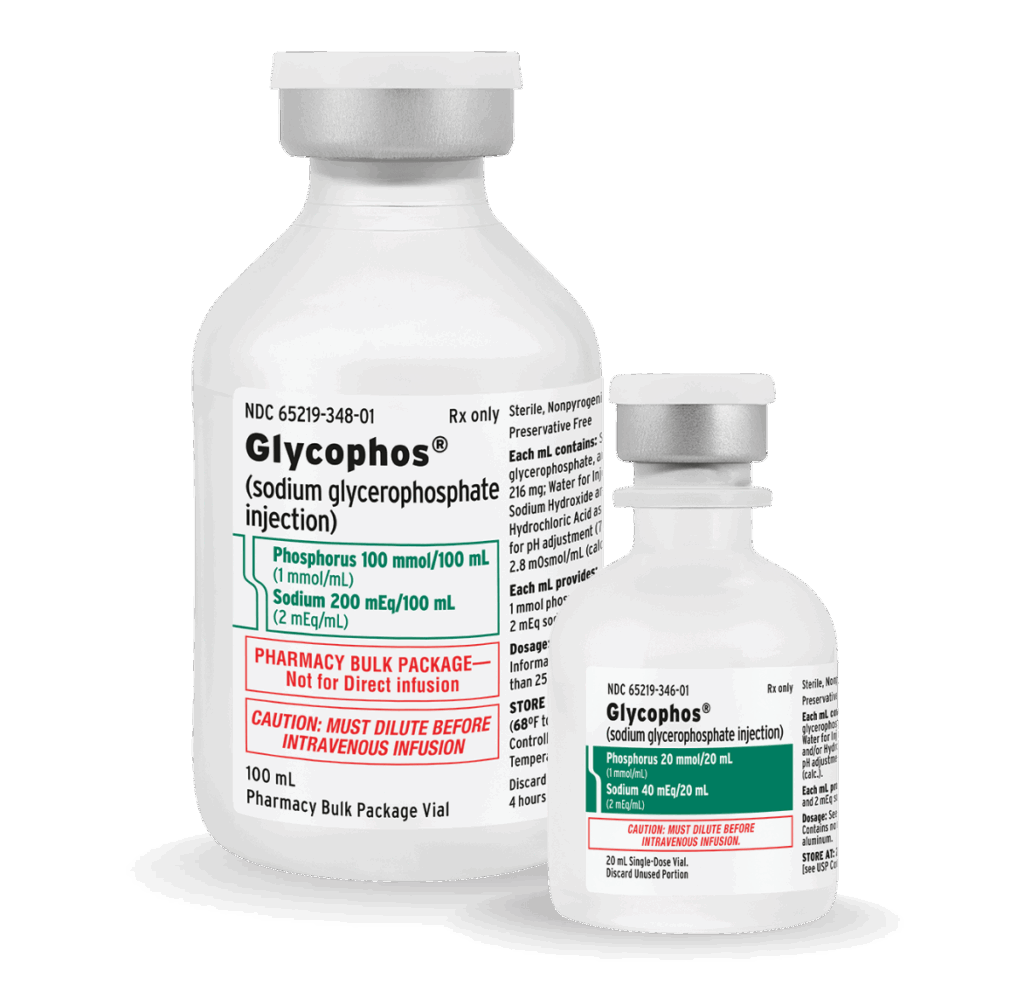
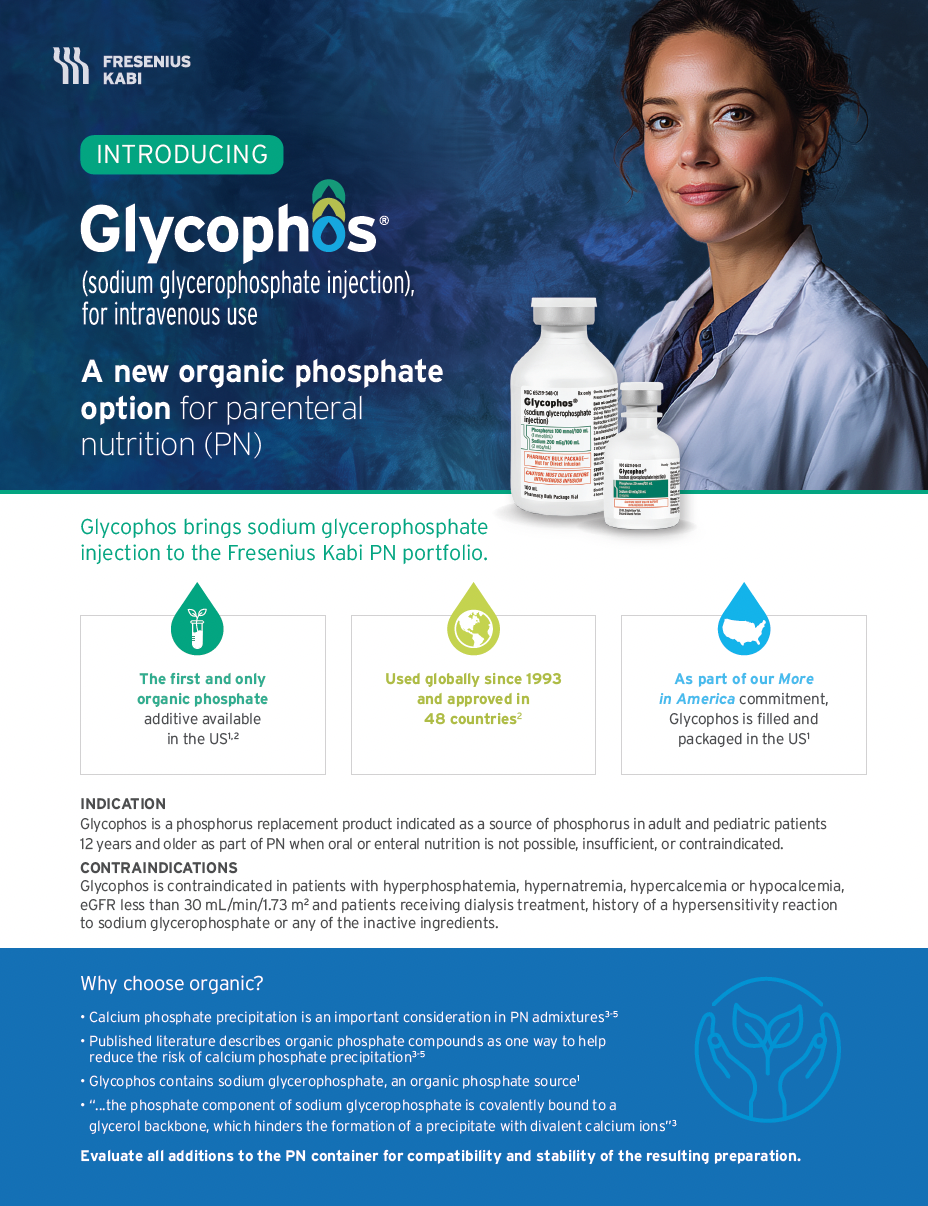
Two Glycophos (sodium glycerophosphate injection) vials side by side, a 100 mL Pharmacy Bulk Package and a 20 mL Single-Dose Vial, each with silver caps and printed dosage labels

Recommended Dosing of Glycophos in Adults and Pediatrics 12 Years of Age and Older for PN1

Age Group Phosphorus Dosage
Pediatrics (12 years of age and older) 20 to 40 mmol/day
Adults 20 to 40 mmol/day

The recommended Glycophos daily dosage as part of the PN admixture is dependent on the individual needs of the patient and the amount of phosphorus from other sources. The rate of administration may be dependent on the patient’s individual clinical condition.

In patients with eGFR greater than or equal to 30 mL/min/1.73 m2 to less than 60 mL/min/1.73 m2, start at the low end of the dosage range and monitor serum phosphorus, sodium, calcium, and magnesium levels.

Complete the intravenous infusion of PN admixture with Glycophos within 24 hours after removal from refrigeration. Discard any remaining admixture.

ORDERING INFORMATION
Product Number 344020 344100
Unit of Sale
NDC 65219-
346-20
25-unit tray
348-10
20-unit tray
Description 20 mL single dose vial 100 mL pharmacy bulk package

Glycophos resources

Explore additional Glycophos materials by visiting our Resource Center.
Glycophos can cause serious side effects, including:

  • Blood clots in the lungs: If breathing problems occur, the infusion should be stopped and contact your healthcare provider immediately.
  • High phosphorus levels and low calcium levels: Your healthcare provider will monitor your Phosphorus and Calcium blood levels during and following treatment.
  • Risk of Sodium buildup in the body: Patients who are at risk of fluid buildup or sodium retention such as patients with heart failure, kidney problems, cirrhosis, or swelling — should be monitorered closely.
  • Allergic Reactions: Contact your healthcare provider immediately if you are experiencing the signs and symptoms of an allergic reaction.
  • Aluminum buildup in the body: Increased risk in patients with kidney problems, including preterm infants.
  • Low Magnesium levels: Your healthcare provider will monitor your Magnesium blood levels during treatment.
  • Damage to veins including blood clots: Highly concentrated IV solutions should be infused through central IV line.

The most common side effects of Glycophos include: high phosphorus levels, low calcium levels, high sodium levels, and low magnesium levels in the blood.

These are not all the possible side effects associated with Glycophos. Tell your doctor if you have any side effects that bother you or that do not go away. For specific questions about your health, you should always consult your doctor or a qualified healthcare professional who is responsible for your care.

You are encouraged to report negative side effects of Glycophos.Contact Fresenius Kabi USA, LLC at: 1-800-551-7176 or FDA at: 1-800-FDA-1088 or www.fda.gov/medwatch.

Intended for US audiences only.

This Important Safety Information does not include all the information needed to use GLYCOPHOS® (sodium glycerophosphate injection), safely and effectively. To learn more about GLYCOPHOS® (sodium glycerophosphate injection), talk to your doctor . Please see the accompanying full prescribing information for GLYCOPHOS® (sodium glycerophosphate injection) for additional important information. The full prescribing information is also available at www.FreseniusKabiNutrition.com.


For Healthcare Professionals

Glycophos® (sodium glycerophosphate injection), for intravenous use

IMPORTANT SAFETY INFORMATION

INDICATIONS AND USAGE

Glycophos is a phosphorus replacement product indicated as a source of phosphorus in adults and pediatric patients 12 years and older as part of parenteral nutrition (PN) when oral or enteral nutrition is not possible, insufficient, or contraindicated.

DOSAGE AND ADMINISTRATION

Glycophos is not for direct intravenous infusion. Glycophos must be diluted and used as a PN admixture.

CONTRAINDICATIONS
Glycophos is contraindicated in patients with hyperphosphatemia, hypernatremia, hypercalcemia or hypocalcemia, eGFR less than 30 mL/min/1.73 m2 and patients receiving dialysis treatment, history of a hypersensitivity reaction to sodium glycerophosphate or any of the inactive ingredients.

WARNINGS AND PRECAUTIONS

Pulmonary Embolism due to Pulmonary Vascular Precipitates: If signs of pulmonary distress occur, stop the infusion and initiate a medical evaluation.
Hyperphosphatemia and Hypocalcemia: Monitor serum phosphorus and calcium concentrations during and following infusion.
Risk of Sodium Retention: Closely monitor patients with congestive heart failure, renal impairment, cirrhosis, and other conditions with risk for edema and/or sodium retention. Consider all sources of sodium, including concomitant use of sodium-retaining drugs, and adjust dose as needed.
Hypersensitivity Reactions: Monitor for signs or symptoms and discontinue infusion if reactions occur.
Aluminum Toxicity: Increased risk in patients with renal impairment, including preterm infants.
Hypomagnesemia: Reported in patients with hypercalcemia and diabetic ketoacidosis. Monitor serum magnesium concentrations during treatment.
Vein Damage and Thrombosis: Infuse concentrated or hyperosmolar solutions through a central catheter.

ADVERSE REACTIONS
Common adverse reactions include hyperphosphatemia, hypocalcemia, hypernatremia, and hypomagnesemia.

To report SUSPECTED ADVERSE REACTIONS, contact Fresenius Kabi USA, LLC at 1-800-551-7176, option 5, or FDA at 1-800-FDA-1088 or www.fda.gov/medwatch.

This Important Safety Information does not include all the information needed to use Glycophos safely and effectively. Please see full prescribing information, for intravenous use at www.FreseniusKabiNutrition.com.

Glycophos can cause serious side effects, including:

  • Blood clots in the lungs: If breathing problems occur, the infusion should be stopped and contact your healthcare provider immediately.
  • High phosphorus levels and low calcium levels: Your healthcare provider will monitor your Phosphorus and Calcium blood levels during and following treatment.
  • Risk of Sodium buildup in the body: Patients who are at risk of fluid buildup or sodium retention such as patients with heart failure, kidney problems, cirrhosis, or swelling — should be monitorered closely.
  • Allergic Reactions: Contact your healthcare provider immediately if you are experiencing the signs and symptoms of an allergic reaction.
  • Aluminum buildup in the body: Increased risk in patients with kidney problems, including preterm infants.
  • Low Magnesium levels: Your healthcare provider will monitor your Magnesium blood levels during treatment.
  • Damage to veins including blood clots: Highly concentrated IV solutions should be infused through central IV line.

The most common side effects of Glycophos include: high phosphorus levels, low calcium levels, high sodium levels, and low magnesium levels in the blood.

These are not all the possible side effects associated with Glycophos. Tell your doctor if you have any side effects that bother you or that do not go away. For specific questions about your health, you should always consult your doctor or a qualified healthcare professional who is responsible for your care.

You are encouraged to report negative side effects of Glycophos.Contact Fresenius Kabi USA, LLC at: 1-800-551-7176 or FDA at: 1-800-FDA-1088 or www.fda.gov/medwatch.

Intended for US audiences only.

This Important Safety Information does not include all the information needed to use GLYCOPHOS® (sodium glycerophosphate injection), safely and effectively. To learn more about GLYCOPHOS® (sodium glycerophosphate injection), talk to your doctor . Please see the accompanying full prescribing information for GLYCOPHOS® (sodium glycerophosphate injection) for additional important information. The full prescribing information is also available at www.FreseniusKabiNutrition.com.


For Healthcare Professionals

Glycophos® (sodium glycerophosphate injection), for intravenous use

IMPORTANT SAFETY INFORMATION

INDICATIONS AND USAGE

Glycophos is a phosphorus replacement product indicated as a source of phosphorus in adults and pediatric patients 12 years and older as part of parenteral nutrition (PN) when oral or enteral nutrition is not possible, insufficient, or contraindicated.

DOSAGE AND ADMINISTRATION

Glycophos is not for direct intravenous infusion. Glycophos must be diluted and used as a PN admixture.

CONTRAINDICATIONS
Glycophos is contraindicated in patients with hyperphosphatemia, hypernatremia, hypercalcemia or hypocalcemia, eGFR less than 30 mL/min/1.73 m2 and patients receiving dialysis treatment, history of a hypersensitivity reaction to sodium glycerophosphate or any of the inactive ingredients.

WARNINGS AND PRECAUTIONS

Pulmonary Embolism due to Pulmonary Vascular Precipitates: If signs of pulmonary distress occur, stop the infusion and initiate a medical evaluation.
Hyperphosphatemia and Hypocalcemia: Monitor serum phosphorus and calcium concentrations during and following infusion.
Risk of Sodium Retention: Closely monitor patients with congestive heart failure, renal impairment, cirrhosis, and other conditions with risk for edema and/or sodium retention. Consider all sources of sodium, including concomitant use of sodium-retaining drugs, and adjust dose as needed.
Hypersensitivity Reactions: Monitor for signs or symptoms and discontinue infusion if reactions occur.
Aluminum Toxicity: Increased risk in patients with renal impairment, including preterm infants.
Hypomagnesemia: Reported in patients with hypercalcemia and diabetic ketoacidosis. Monitor serum magnesium concentrations during treatment.
Vein Damage and Thrombosis: Infuse concentrated or hyperosmolar solutions through a central catheter.

ADVERSE REACTIONS
Common adverse reactions include hyperphosphatemia, hypocalcemia, hypernatremia, and hypomagnesemia.

To report SUSPECTED ADVERSE REACTIONS, contact Fresenius Kabi USA, LLC at 1-800-551-7176, option 5, or FDA at 1-800-FDA-1088 or www.fda.gov/medwatch.

This Important Safety Information does not include all the information needed to use Glycophos safely and effectively. Please see full prescribing information, for intravenous use at www.FreseniusKabiNutrition.com.

If you still can't find what you're looking for regarding our PN products or Fresenius Kabi Nutrition, let us know and we can help.

Contact us

References: 1. Glycophos Prescribing Information, Fresenius Kabi USA, LLC. 2026. 2. Data on file 6/1/26. 3. Boullata JI, Mirtallo JM, Sacks GS, et al. Parenteral nutrition compatibility and stability: A comprehensive review. JPEN J Parenter Enteral Nutr. 2022;46(2):273-299. 4. Boullata JI, Salman G, Mirtallo JM, et al. Parenteral nutrition compatibility and stability: Practical considerations. Nutr Clin Pract. 2024;39(5):1150-1163. 5. Allwood MC, Kearney MC. Compatibility and stability of additives in parenteral nutrition admixtures. Nutrition. 1998;14(9):697-706.